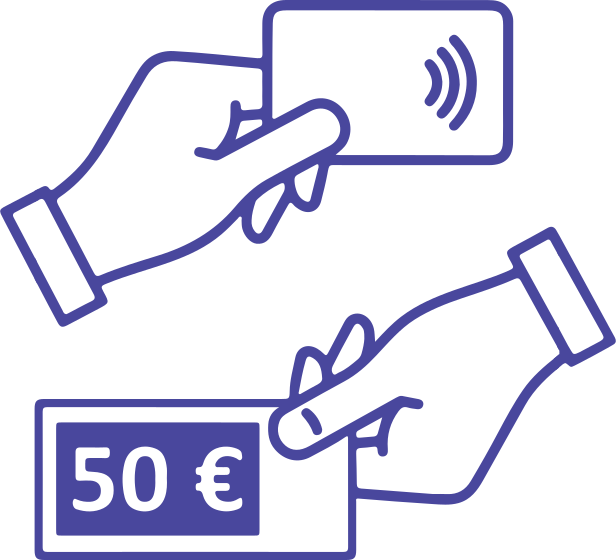
Exchange voucher for cash

Do you receive the payment card and only 50 € cash per month? If you need more cash, let’s exchange!

  1. Buy a voucher in the stores Aldi, Lidl, Edeka, Kaufland, Rewe or DM for 50€
  2. Bring the voucher to an exchange point!
    Here you will get cash for the vouchers.

Where?

Diakoniekirche Luther
Lutherstraße 2-4
68169 Mannheim

When?

Every 2nd Wednesday of the month from 4:30 pm to 7:00 pm.

The next dates:

Voucher Distribution

Are you in solidarity with people with payment cards and would like to participate in our actions? Get your shopping voucher at one of our distribution points!

Where are vouchers available?

ewwe longt´s
Kobellstraße 20
68167 Mannheim

Friday 7:00 pm - 10:00 pm

Basement Bikes
Werftstraße 29
68159 Mannheim

Tuesday 10:00 am - 1:00 pm, 2:00 pm - 6:00 pm
Thursday 4:00 pm - 8:00 pm

Café Arranca im ASV Mannheim
Beilstraße 12
68159 Mannheim

Every 3rd Sunday of the month from 7:00 pm

Depending on availability, there are usually vouchers from Aldi, Lidl, Edeka, Kaufland, Rewe or DM for 50€

Statement from the Initiative
‘Stop Payment Card Mannheim’

Since the end of 2024, the payment card is being introduced nationwide in Germany for refugees covered by the 'Asylum Seekers Benefits Act'. The introduction of the payment card leads to enormous problems for both refugees and the administration, and is described by refugee organizations as a racist instrument. That’s why we founded the initiative ‘Stop Payment Card Mannheim’ to organize exchange markets, help refugees, and oppose this racist symbolic policy.

Read moreShow less

What is the payment card?

Refugees who are covered by the 'Asylum Seekers Benefits Act' receive the money they are entitled to through the payment card instead of cash or to an account. The payment card looks like a normal debit card but works very differently. Only 50€ cash can be withdrawn per month and transfers are only very limited. These restrictions massively hinder participation in social life and successful integration.

Why is the payment card problematic?

Whether at the flea market, at the weekly market, or for the children's lunch in school - cash is enormously important in Germany and restricting it to 50€ per person creates an unnecessary hardship and pure discrimination. Additionally, not all stores accept the payment card as a means of payment. Transfers are also indispensable in all areas of life. Membership fees in a club, the Germany ticket, the electricity provider - to participate in social life, we need the ability to make transfers. However, with the payment card, this is only possible, if at all, after explicit approval, thereby creating huge integration barriers instead of removing them. Constant technical errors, data protection issues, or unlawful fees are just a few of the many issues related to the payment card, not to mention enormous administrative burdens.

Why was the payment card introduced?

The introduction of the payment card was decided by the federal government and state premiers in November 2023. There were mainly two reasons given for the introduction, both of which are untenable.

  1. “The reduced cash availability for asylum seekers is intended to prevent them from sending money back to their home countries.”

    • However, this assumption is incorrect, as shown by a recent study by the German Institute for Economic Research, based on representative household surveys from the Socio-Economic Panel (SOEP). Only seven percent of refugees send money abroad – and the trend is decreasing.
  2. "It should reduce administrative work for municipalities, as the previous cash payouts are eliminated and the money is instead transferred.”

    • Very many municipalities reject the introduction of the payment card because it represents an additional workload for the municipalities.
    • Manuela Skotnik from the Department of Labor and Social Affairs in Mannheim says: “The workload is enormous. In our assessment, it will remain higher in the long term than before.”
    • The payment card is estimated to cost 68 million € annually in additional administrative expenses.

How will the payment card develop in the future?

The introduction of the payment card is not only a racist instrument intended to hinder people who have fled poverty and war from integrating into Germany, but it must also be seen in the context of the increasingly right-conservative political climate. In Hamburg, the payment card is now supposed to be extended to other social benefit recipients. It can be assumed that this system will continue to expand. We are seeing an increasing stigmatization of people in need. Instead of offering help and support, more and more exclusion is being practiced.

Contact & Donations

We are an open structure and meet regularly to coordinate the next steps. Do you have interest in being active against the payment card? Then come to one of our next meetings or get in touch with us.

Contact

Donations

Röm.-Kath.
Kirchengemeinde Heidelberg
DE77 6725 0020 0001 2061 76
Zweck: Gutschein 2813-GU-MA

The intended purpose is important, otherwise, the donation cannot be allocated!